

Words.
Healing, Resilience, & Strength

These are words that many, including myself, have contention with how they are sometimes used- in other words, ‘toxic positivity.’ This post will help clarify the way I use these words throughout my work and in this blog.
Healing.
Humans are hardwired for survival, and problems arise when we get stuck in survival mode. A hard truth is that trauma has a cumulative effect that leads to further trauma, building layer upon layer- and grief and trauma have a whole lot in common. When I use the word ‘healing,’ particularly with regard to grief and trauma, it is never intended to imply that we get over whatever it is that has created the need to heal; it is intended to mean that despite what we’ve been through, there are ways to eventually get out of survival mode by healing aspects of ourselves in mind, body, and spirit. Healing, to me, is about getting out of survival mode. It’s getting in touch with the parts of ourselves that have been buried beneath these layers and finding peace in that space, allowing us to eventually thrive- in spite of or sometimes because of our painful experiences.
Resilience.
Resilience is not about pretending what happened didn’t happen, or simply providing an outward appearance of normalcy. The fact is, we are changed by our experiences. We’re supposed to be. One thing we can count on in this life is that hardships and change are inevitable. We are in a constant state of evolution and growth as individuals and as a society, whether we want to be or not.
Resiliency is strengthened by doing the hard work of healing. It provides stamina to face future challenges and changes with a greater outcome of recoverability. It reinforces growth through adversity- even if growth wasn’t what we set out for. Resilience provides the ability to seek out whatever good we can find in the worst of circumstances, and ironically, this also strengthens resiliency.
We often hear how resilient kids are. Yes, they are resilient in the way that they are generally able to quickly adapt to their circumstances because of the survival wiring, but relying on resiliency to get a child through is not enough. Some of the ways in which they are forced to adapt in childhood can end up hurting them in adulthood. Children need to be taught and modeled healthy ways of coping- particularly in a society that glorifies unhealthy ways. They need to feel safe, to be heard, to be protected, and to have a loving support system they can lean on and trust. Humans have a biological need for safety and connection, and being provided these key ingredients during the formative developmental years of childhood provides a solid foundation that serves them well into adulthood. I’ll get into more detail about safety and connection in another post, as it is also the foundation for healing.
Strength.
“You are so strong.” I can’t count how many times I’ve heard this throughout the years. I used to cringe every time because I didn’t feel strong at all- I just wasn’t given a choice. However, many years later, I learned to reframe strength to mean survival and decided to own the compliment. “Yes, I’m getting through the best way I know how right now and am somehow still standing- I appreciate you noticing.”
For probably the first decade after my loss, what looked like strength came mostly in the form of avoidance, denial, distractions, putting on a good appearance that everything is okay, holding onto people that harmed instead of helped, and holding everything in because as you all might have figured out, we tend to repel people with our pain and grief. I had pretty much all of the unhealthy ways of coping down pat. Don’t get me wrong- just being able to survive some of the crap life throws at us IS strength. Unfortunately, these unhealthy ways of coping tend to give the illusion of strength and resiliency. I learned the hard way that over time, this illusion can eventually kill you.
Here are some healthy coping strategies that are also strengths:
practicing healthy boundaries
letting go of harmful people (it’s actually more lonely to be around a bunch of people who don’t contribute anything positive to your life than to be alone in peace), and seeking out safe people who have the capacity to be supportive
allowing yourself to feel and express emotions- even the negative ones
identifying your needs, learning ways to meet them, and making them a priority
showing up for yourself with compassion, having your own back, and seeking out ways to heal; and finally,
giving yourself grace in times of weakness- in other words, giving yourself the space and grace to be human and make mistakes.
I call these strengths because this stuff is not easy to implement, and does not necessarily come naturally. It is not lost on me that some of these suggestions come with a certain amount of privilege, and some of the strongest among us are without these privileges. Most of us don’t learn these things growing up, and it’s not often that they are modeled for us, either. Despite conditioning that can imply weakness with some of these things, these are considerable strengths. By the way, kindness is also a huge strength that is often mistaken for weakness- one of my biggest pet peeves…
Newly Widowed Program
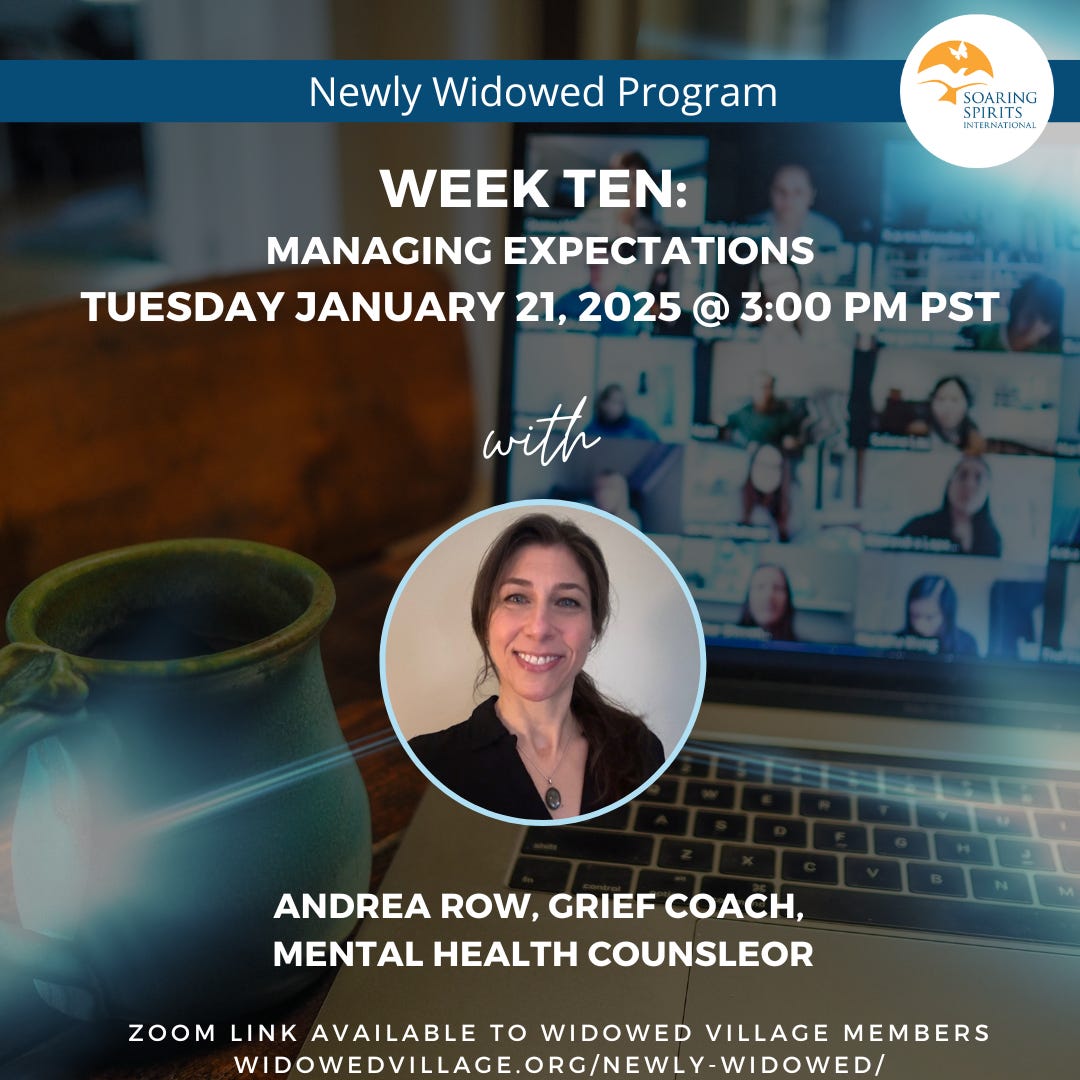
This Tuesday evening, I have the honor of presenting for the Soaring Spirits International Newly Widowed Program on Widowed Village this week! I'll be talking about managing expectations in widowhood and am excited to share some of the things I've learned over the past sixteen years since my loss, both from my personal experience and my perspective as a therapist and grief coach. I’m also excited to see a couple of my old friends from Camp Widow who are also volunteering for this event! If you are a newly widowed person and would like to participate, register for free through Widowed Village. Once registered, find the Newly Widowed Virtual Program tab on the right and join us from 6-7:30pm EST (3-4:30pm PST)!
Weekly Affirmation
“I can put my pieces back together differently.”
After a profound loss, it can feel like we’re shattered into a million pieces. Although we are changed by these experiences, it does not mean we will remain shattered. Some pieces might not be recovered and the rest may not fit back together the same way, but over time, we can still make something beautiful with what we have, and with what we create. In time, with love and intention, it can be a different kind of beautiful.
Thank you for being here. <3